Just Do Your Kegels
Why "Just Do Your Kegels" is Failing Postpartum Moms (And What Clinical Science Says to Do Instead)
If you went to your 6-week postpartum checkup, mentioned that you were experiencing leaking, lower back pain, or pelvic heaviness, and were handed a generic pamphlet that said "just do your Kegels," I want to tell you something incredibly important:
You were failed by the system.
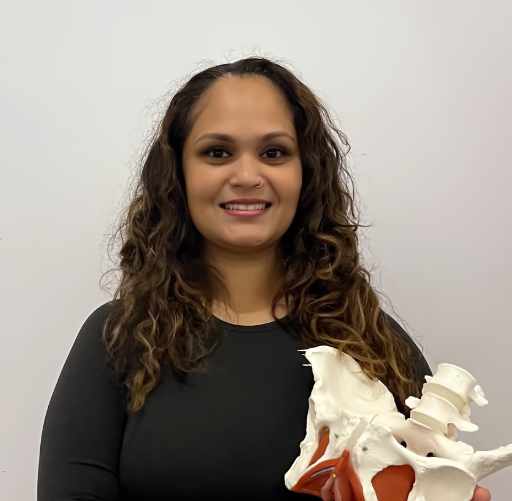
As a Doctor of Physical Therapy (DPT), a birth doula, and a mom of two, I see this exact scenario play out every single week. In the conventional medical model, pregnant women receive 12 or more prenatal visits with their OB-GYN. Yet, once that baby is born, moms typically receive just one rushed checkup in the first year postpartum.
At that single visit, many moms are cleared for exercise without a functional assessment, leaving them to navigate a highly demanding physical recovery on their own. The default advice—"do your Kegels"—treats the pelvic floor like an isolated muscle that just needs to be squeezed over and over again.
But your body doesn’t work in isolation. Motherhood is a high-impact, dynamic sport. Today, we are breaking down the clinical evidence showing why isolated Kegels aren’t the answer, and how to actually restore your deep core system.
Why Squeezing More is Making You Leak
To understand why traditional Kegels often worsen symptoms like leaking and pelvic pressure, we have to look at muscle physiology.
Imagine you are walking, and your calf muscle suddenly locks up in a painful "Charley horse" cramp. How would you fix it? You wouldn't try to cure the cramp by clenching and squeezing your calf muscle as hard as you can. Doing so would only make the spasm worse. Instead, you would gently stretch, lengthen, breathe, and release the muscle.
Many postpartum moms do not actually have a weak pelvic floor. Instead, they have an overactive, hypertonic, and exhausted pelvic floor.
Because pregnancy shifts your posture, your body naturally searches for stability. To cope, many moms find themselves constantly:
Clenching their butt cheeks while standing at the kitchen counter.
Sucking in their stomachs all day long.
Bracing their abs while carrying an awkward car seat or a heavy toddler.
When you grip these muscles 24/7, your pelvic floor becomes chronically tight. A muscle that is already fully contracted cannot absorb shock. If your pelvic floor is stuck in a state of constant tension, it cannot reflexively squeeze when you laugh, cough, sneeze, or run.
Doing 100 Kegels a day on top of an already over-tight system doesn't make you stronger; it simply drives muscle exhaustion and causes more leaking.
What the Clinical Research Actually Says
You don't have to just take my word for it. The transition away from isolated Kegels is supported by robust neuro-mechanical and clinical research. Let’s look at three foundational studies that explain how our bodies manage posture, pressure, and pelvic floor activation.
1. The Postural & Breathing Connection
In a landmark study published in Neurourology and Urodynamics, researchers P.W. Hodges, R. Sapsford, and L.H.M. Pengel (2007) investigated the postural and respiratory functions of the pelvic floor muscles (PFM).
Using electromyographic (EMG) recordings during movement, they discovered that the pelvic floor is an essential component of the body’s anticipatory postural adjustments.
The Anticipatory Reflex: When you move your arms or legs, your pelvic floor activates in advance of the movement to stabilize your spine and pelvis.
The Breath Link: They also confirmed that the pelvic floor is deeply involved in quiet breathing, showing distinct coordination with expiration.
Your pelvic floor is designed to fire automatically as a dynamic stabilizer while you move through space and breathe, not while you sit perfectly still on a treatment table trying to isolate a squeeze.
2. The Abdominal-Pelvic Floor Co-Activation Synergy
Many fitness programs treat the "abs" and the "pelvic floor" as two entirely different workouts. However, clinical science proves they are functionally inseparable.
A study by R.R. Sapsford, P.W. Hodges, and colleagues (2001) examined the relationship between voluntary abdominal maneuvers and pelvic floor activation. They found:
Whenever a subject contracted their pelvic floor, the deep abdominal muscles—specifically the transversus abdominis (TrA) and internal obliques (OI)—automatically fired as well.
Conversely, when subjects performed specific abdominal exercises (like "hollowing" or drawing in the lower belly), it automatically triggered a contraction of the pubococcygeus (PC) pelvic floor muscle.
Your pelvic floor and deep core function as a unified, pressurized "canister." You cannot truly train one without the other. This is why we must focus on co-activation, alignment, and breath-holding dynamics. This also solidifies why you shouldn't constantly be sucking in your abdominal muscles (this can lead to an overly tight pelvic floor).
3. The Incontinence Paradox: Why Squeezing Harder Isn't the Answer
If incontinence were simply a matter of a "weak" pelvic floor, we would expect incontinent women to show very low muscle activity. But a groundbreaking study by Michelle D. Smith, Michel W. Coppieters, and Paul W. Hodges (2007) proved the exact opposite.
The researchers compared pelvic floor and abdominal muscle responses to sudden postural loading in continent versus incontinent women. The findings completely challenged conventional assumptions:
Hyper-reflexive Compensation: Women with stress urinary incontinence actually demonstrated increased raw pelvic floor muscle EMG activity at baseline and during postural responses compared to continent women.
Abdominal Over-Drive: Incontinent women also showed significantly increased activity in their obliquus externus (OE) abdominal muscles.
Women suffering from leaking aren't suffering from "lazy" muscles. Their pelvic floor and outer abdominal muscles are actually overworking as a compensation strategy to cope with a lack of stability and poor pressure management. Squeezing harder via Kegels only adds fuel to this hyperactive fire.
How to Actually Restore Your Core Utilizing The Fit2Push Roadmap
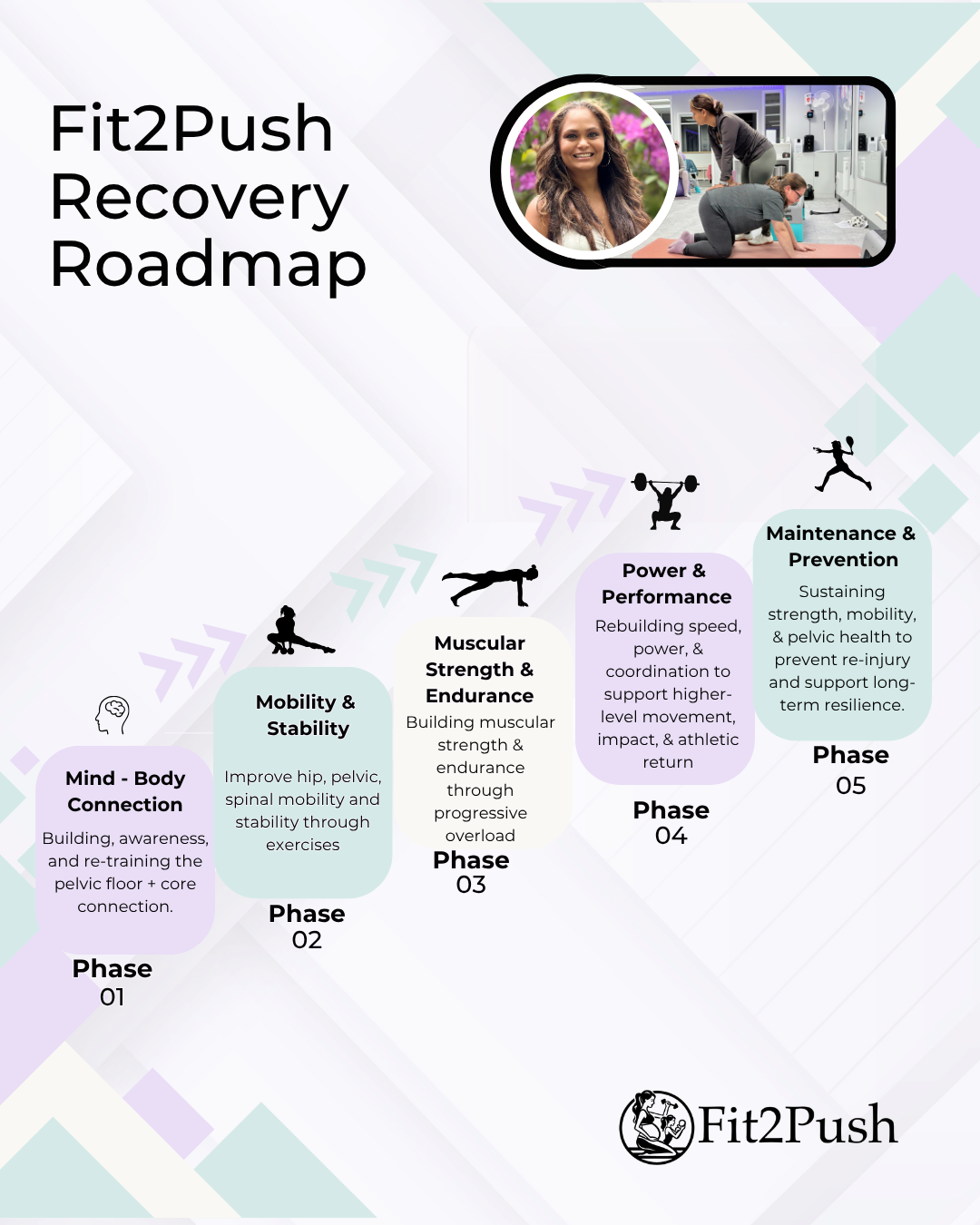
If isolated Kegels aren’t the answer, what is? We need to train your core-pelvic floor system for the actual sport of motherhood. Real restoration requires a three-step postural approach:
Step 1: Restore Structural Alignment
Before you try to strengthen any muscle, you have to look at the bones they attach to. During pregnancy, your rib cage flares and your pelvis tilts forward. If you stay stuck in this posture, your pelvic floor and deep transversus abdominis lose their mechanical advantage. By restoring structural alignment (stacking your ribs directly over your pelvis), your core muscles can finally fire automatically.
Step 2: Master Pressure Management
Your core is a pressure system. If you suck in your stomach, you force pressure down against your pelvic floor. We teach you how to use 360-degree diaphragmatic breathing to naturally allow your pelvic floor to lengthen and drop on an inhale, and reflexively contract and lift on an exhale.
Step 3: Train with Integrated, Functional Movement
We get you off the treatment table. According to clinical data, integrated movements like a bridge, a lunge, or a dynamic squat recruit far more pelvic floor muscle fibers than an isolated squeeze. We train your body to manage pressure dynamically while you lift, carry, bend, and move.
Let's Stop the Guesswork
Postpartum recovery is a medical journey, not a fitness trend. You deserve specialized care that looks at your nervous system, your alignment, and your unique maternal journey.
If you are ready to stop guessing and start restoring your system, I am here to support you.
In-Home Concierge Care: If you are local to Mercer County, NJ (Ewing, Princeton, Pennington, and surrounding areas), I bring Doctor of Physical Therapy evaluations and treatment straight to your living room—no childcare required.
Virtual Pelvic PT Consultation: No matter where you are, we can meet on screen to troubleshoot your symptoms, review your alignment, and build a custom postpartum movement roadmap.
🔗 [Click Here to Book Your Free 15-Minute Consultation Call Today]
Let's build a system that actually restores you.
Scientific References
Hodges, P. W., Sapsford, R., & Pengel, L. H. M. (2007). Postural and respiratory functions of the pelvic floor muscles. Neurourology and Urodynamics, 26(3), 362-371.
Sapsford, R. R., Hodges, P. W., Richardson, C. A., Cooper, D. H., Markwell, S. J., & Jull, G. A. (2001). Co-activation of the abdominal and pelvic floor muscles during voluntary exercises. Neurourology and Urodynamics, 20(1), 31-42.
Smith, M. D., Coppieters, M. W., & Hodges, P. W. (2007). Postural response of the pelvic floor and abdominal muscles in women with and without incontinence. Neurourology and Urodynamics, 26(3), 377-385.