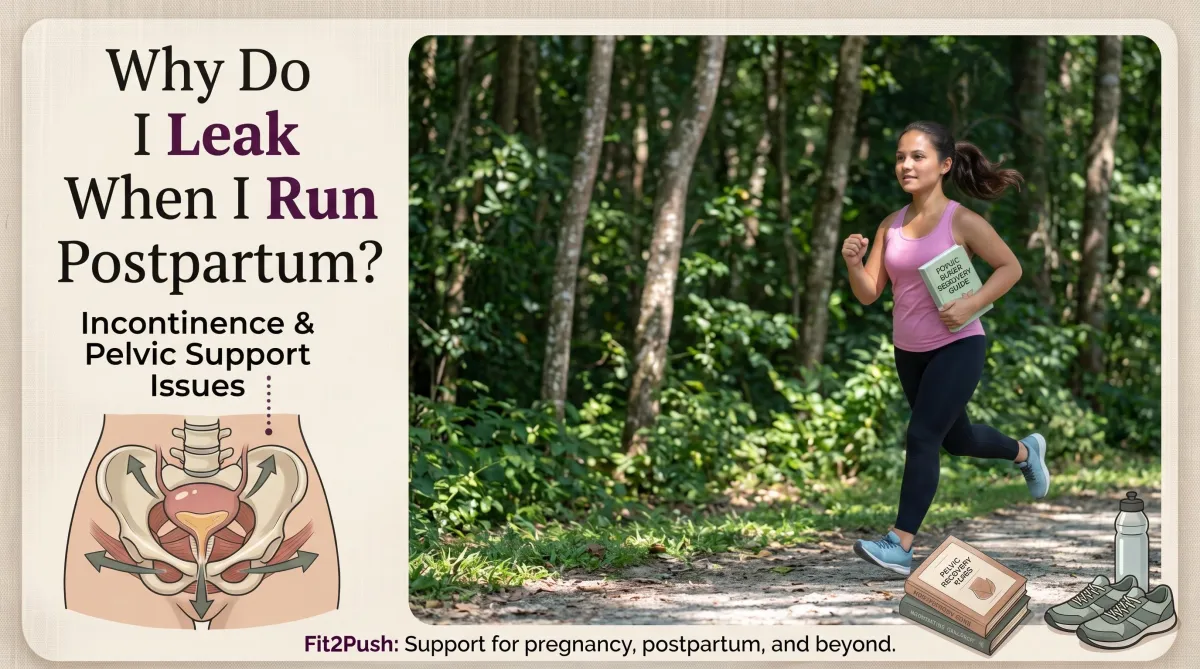
Why Do I Leak When I Run Postpartum?
Why Do I Leak When I Run Postpartum?
You finally find a small window to run. The school bags are packed, the stroller is by the door, and the end-of-summer calendar is turning back into a real schedule. Then a few minutes into the run, you leak.
That symptom can feel like a verdict: maybe your body is not ready, maybe running is the problem, or maybe you just need to do more Kegels. But leakage during running is not a character flaw and it is not automatically proof that you have to quit. It is information about how your bladder, pelvic floor, trunk, hips, training load, and recovery are managing impact together.
THE SHORT ANSWER Leaking with running deserves attention, but it does not identify one universal cause. A useful plan looks at the symptom pattern, the demands of running, your recovery and training history, and what changes when the load changes. |
|---|
What does postpartum leaking while running mean?
Running asks your body to repeatedly absorb and produce force. Continence during that task is not the job of one muscle working in isolation. Your pelvic floor must respond with the rest of your system as your feet hit the ground, your breathing changes, your pace increases, and fatigue builds.
Urine leakage with impact is often described as stress urinary incontinence. The label describes what happens - leakage with an activity that increases pressure or load - but it does not tell us everything about why it happens for one person.
Current evidence supports pelvic-floor muscle training as one useful intervention for urinary incontinence, including in postpartum populations. That does not mean every runner who leaks simply has a weak pelvic floor or needs the same set of contractions. Coordination, timing, endurance, relaxation, strength, bladder habits, whole-body capacity, symptoms, sleep, and the progression of running load may all matter.
Why can leaking show up only when you run?
Impact changes the demand. You may feel fine walking, lifting, or strength training and still notice leakage once you add repeated impact. Passing one task does not guarantee readiness for every task.
Speed and fatigue change the problem. A symptom that begins late in a run, on hills, or during faster intervals gives different information than leakage that begins with the first few steps.
The rest of the week matters. Sleep disruption, feeding, work, childcare, strength training, running volume, and recovery resources can change what your body can manage on a particular day.
Postpartum is not one uniform stage. Birth history, healing, prior symptoms, time away from impact, current fitness, pain, heaviness, urgency, and personal goals all shape the plan. A calendar date alone cannot answer those questions.
Three pieces of incomplete advice
1. “Just stop running.”
Sometimes reducing or temporarily changing impact is appropriate. But a blanket instruction to stop does not explain the symptom or build the capacity needed for a future return. The more useful question is: what dose can you manage now, and what needs to improve before the next progression?
2. “Just do more Kegels.”
Pelvic-floor contractions can be helpful when they match the person and the problem. They are not a complete running program, and more is not automatically better. The pelvic floor also needs to coordinate with breathing and movement, tolerate repeated loading, and relax when appropriate.
3. “Wait until you are farther postpartum.”
Time supports healing, but time alone does not build running capacity. Current return-to-running research favors an individualized, sport-specific, biopsychosocial process rather than one universal postpartum date or pass/fail test.
What can you do next?
Track the pattern, not just the presence of leakage. Notice when it begins, what pace or terrain you were using, whether urgency was present, and what else you felt. Heaviness, pressure, pain, bowel symptoms, or a sudden change are important context.
Adjust the dose without abandoning the goal. Depending on your situation, that might mean shorter intervals, more recovery, a different pace, fewer impact days, or temporarily using another conditioning option. There is no universal modification that fits every runner.
Build more than the pelvic floor. Running also asks for calf, hip, trunk, and whole-body strength; balance; load tolerance; and enough recovery to repeat the work.
Make the plan fit real motherhood. A repeatable plan often beats an impressive plan that cannot survive daycare pickup, work deadlines, feeding, or a rough night of sleep.
Get an individualized assessment when the symptom persists or limits you. A pelvic-health physical therapist can review your history, symptoms, movement, training load, goals, and pelvic-floor function when clinically appropriate and with your consent.
When should you seek care?
Consider individualized pelvic-health care if leakage, urgency, heaviness, pelvic or low-back pain, bowel symptoms, or uncertainty is changing how you run or keeping you from progressing. You do not need to wait until the symptom is severe or until you are “done having babies” to ask for help.
Exercise advice is not emergency care. During pregnancy and the year after birth, seek medical care immediately for urgent maternal warning signs such as chest pain, trouble breathing, fainting, a severe or worsening headache, heavy bleeding, fever, severe abdominal pain, or thoughts of harming yourself or your baby. If something feels unusual or worrying, contact your medical provider.
How Fit2Push can help
Fit2Push provides individualized concierge pelvic-floor physical therapy in Mercer County and nearby Central New Jersey communities. The goal is not to hand every runner the same checklist. It is to understand what your symptoms are telling us, connect the findings to the activity you value, and build a progression that fits your body and your actual life.
If leaking, heaviness, or pain is making every run feel like a gamble, book a private connection call to discuss whether pelvic-floor PT is the right next step.
Frequently Asked Questions
Is leaking while running normal after having a baby?
It can be common, but common does not mean you must ignore it or accept it permanently. Leakage is a symptom worth discussing, especially when it changes your activity or quality of life.
Does leaking mean my pelvic floor is weak?
Not necessarily. Strength may be one factor, but timing, coordination, endurance, relaxation, bladder function, whole-body capacity, impact load, and other clinical factors can contribute. An assessment helps replace guessing with a clearer plan.
Should I stop running if I leak?
There is no universal answer. Some runners may benefit from modifying impact while building capacity; others may need additional assessment. Persistent, worsening, or concerning symptoms deserve individualized guidance.
Can pelvic-floor physical therapy help years postpartum?
Being years postpartum does not automatically make you “too late” for care. Your plan should be based on your current symptoms, goals, health history, and examination findings - not only the date you gave birth.
Read my blog about how to know when you're ready to return to running
Watch my youtube video on leaking when running and what to do about it
For more evidence-informed pregnancy, postpartum, pelvic-floor, and strength education:
Clinical Sources:
James et al., Frontiers in Sports and Active Living (2026). Interdisciplinary, co-designed guide supporting a sport-specific, individualized, biopsychosocial postpartum return to running; the authors note that the guide still requires feasibility and effectiveness testing.
https://www.frontiersin.org/journals/sports-and-active-living/articles/10.3389/fspor.2026.1771882/full
Beamish et al., British Journal of Sports Medicine / PubMed record (2025). Systematic review and meta-analysis on postpartum exercise and pelvic-floor disorders; supports PFMT for some outcomes without establishing a universal plan.
https://pubmed.ncbi.nlm.nih.gov/39694630/
American College of Obstetricians and Gynecologists. Exercise After Pregnancy and Optimizing Postpartum Care; supports gradual activity and ongoing, individualized postpartum care.
https://www.acog.org/womens-health/faqs/exercise-after-pregnancy
https://www.acog.org/clinical/clinical-guidance/committee-opinion/articles/2018/05/optimizing-postpartum-care
CDC Hear Her Campaign. Urgent maternal warning signs during pregnancy and the year after delivery.
https://www.cdc.gov/hearher/maternal-warning-signs/index.html